|
|
|
|
|
|
|
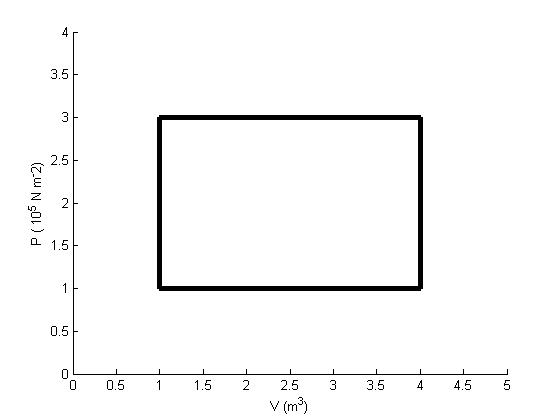
3-17 (a) Calculate the work done by
one kilomole of an ideal gas in reversibly traversing the cycle shown below
ten times. (b) Indicate the direction
of the traversal around the cycle if the net work is positive. |
|
|
|
|
|
|
|
|
|
|
|
(a)
Calculate the work done by one kilomole of an ideal
gas in reversibly traversing the cycle shown below ten times |
|
|
|
|
|
To
be clear let’s refer to each side of the cycle in an obvious way of left,
right, top and bottom. Clearly left
and right are isovolumetric processes; while, top and bottom are isobaric
processes. |
|
|
|
|
|
For
isovolumetric, there is no change in volume and since work is PdV, there is now work done for those process, left or
right. |
|
|
|
|
|
For
isobaric processes, we know for an ideal gas work is given by: |
|
|
|
|
|
|
|
|
|
|
|
For
Top we have |
|
|
|
|
|
|
|
|
|
|
|
|
|
|
|
|
|
|
|
|
The
sign depends on the direction of the process going from small volume to large
would be + (left to right) |
|
|
|
|
|
For
Bottom we have |
|
|
|
|
|
|
|
|
|
|
|
|
|
|
|
|
|
|
|
|
Again
the sign depends on the direction of the process going from small volume to
large would be + (left to right) |
|
|
|
|
|
Now
for one cycle the directions for top and bottom are reversed, so the total
work done is the difference |
|
|
|
|
|
|
|
|
|
|
|
+
sign would result if the cycle is clockwise, - sign
if counter-clockwise. |
|
|
For
ten cycles we multiply above by 10 and get |
|
|
|
|
|
|
|
|
|
|
(b)
Indicate the direction of the traversal around the cycle if the net work is positive. |
|
|
|
|
|
|
|
|
|
|
|